Geochemistry & Isotope Biogeochemistry Group
Breaking News:
September, 20th, 2023:
Denise Otto, former BSc student in the BGC group receives the Otto-Krümmel Förderpreis 2023 for her BSc thesis. Congratulations and good luck for the future!
June 2023:
Michael E. Böttcher is appointed as Associate Editor for the new international scientific jounal Geo-Bio Interfaces, published by Cambridge University Press
May 2023:
Antonia C. Schell and Cátia M. Ehlert von Ahn defended their MSc and PhD theses at the University of Greifswald very successfully. Congratulations!
December 2022:
Michael Böttcher is honored by a full membership in Sigma Xi, The Scientific Research Honor Society
***
December, 2021:
Michael E. Böttcher is appointed as Associate Editor in the Editorial Board of the international journal "Isotopes in Environmental & Health Studies"
September 2018:
In collaboration with Swiss colleagues, the research group discovers for the first time a substantial isotope effect for Ba isotopes and presents a new model for oxygen isotope fractionation in the aquatic hyper-alkaline carbonate-forming environments
European Association of Geochemistry (EAG) supports Stable Isotope Session at EGU 2023 in Vienna
This year, for the eleventh time since 2012, the European Association of Geochemistry (EAG) is co-organizing and supporting the session
'Application of Stable Isotopes in Biogeosciences'.
Conveneers are: Michael E. Böttcher (IOW Warnemünde), Kirstin Dähnke (HZG Geesthacht),
Gerd Gleixner (MPI Jena), Anne-Désirée Schmitt (University of Strasbourg)
Outstanding reviewer PPP
May 2017:
Michael Böttcher was awarded as 'Outstanding Reviewer' for the international scientific journal Paleogeography, Paleoclimatology, Paleoecology.
Erfolg durch Eisernen Vorhang
Auf der diesjährigen internationalen ECSA56 (Coastal Systems in Transition)-Konferenz in Bremen wurde ein Beitrag, den der IOW-Doktorand Marko Lipka aus der AG Geochemie & Isotopen-Biogeochemie vorgestellt hat, mit dem diesjährigen Posterpreis ausgezeichnet. So herausgestellt wurde das Poster mit dem Titel:
„Submarine Groundwater Discharge: A source of P and DIC for the southern Baltic Sea
and the role of an Iron Curtain“
des Autor*innenkollektivs: Lipka, Sültenfuß, Wu, Escher, Schmiedinger, Struck, Dellwig & Böttcher. Darin geht es um die Bedeutung von Grundwasser als Quelle von Phosphat und gelöstem anorganischen Kohlenstoff für die Küstengewässer der Ostsee und die Bedeutung von Eisen-Oxyhydroxid Fällungen an Quellwasser-Austritten für die Phosphat-Retention.
Outstanding reviewer GCA
In November 2016, Michael Böttcher was awarded as 'Outstanding Reviewer' for the international scientific journal Geochimica et Cosmochimca Acta.
Happy Birthday (Bio)Geochemistry!
In January 2016, we are celebrating the 10th anniversary of the Geochemistry & Isotope Biogeochemistry Group at the Leibniz IOW, Germany.
Top of the Isotopes
September, 29th, 2015, University of Heidelberg: Professor Dr. Michael Böttcher, head of the Geochemistry & Isotope-Biogeochemistry Group at IOW, was elected as vice speaker of the German Association of Stable Isotope Research (GASIR) during the annual meeting. The GASIR is an association of scientists coming from diverse disciplines. All in common is the application of different stable isotope systems in research.
More informations under: www.gasir.de
Outstanding reviewer EPSL
In June 2015, Michael Böttcher was awarded as 'Outstanding Reviewer' for the international scientific journal Earth & Planetary Science Letters.
Chemical Geology
Starting on August 1st, 2013, Prof. Dr. Michael Böttcher took the responsibility as (co) Editor-in-Chief of the renowned international scientific journal Chemical Geology. He is responsible for the fields: Biogeochemistry, Stable Isotope Geochemistry, Hydrogeochemistry, Low-Temperature Water-Rock Interactions, Carbon and Sulfur Geochemistry, and Paleoceanography.
More informations under: http://www.journals.elsevier.com/chemical-geology/
*******************************************************************************************************************************************************************
The key approach of the main research activities are focuses on the process-oriented investigation (field, experiment, model) of separated and connected biogeochemical element cycles with the use of special analytical approaches as stable isotope (S, O, C, H) and redox-sensitive element partitioning (e.g., S, C, O, P, Fe, Mn, Mo). It is reflected by the main research areas:
• Biogeochemistry
• Stable Isotope Geochemistry
• Aquatic Geochemistry
• Sediment Geochemistry
• Environmental Geochemistry
• Experimental Geochemistry
• Mineral authigenesis (carbonates, phosphates, sulfates and sulfides)
• Proxy formation processes and application to paleo-environmental changes
• Redox and trace element biogeochemistry
Current Hot Topics:
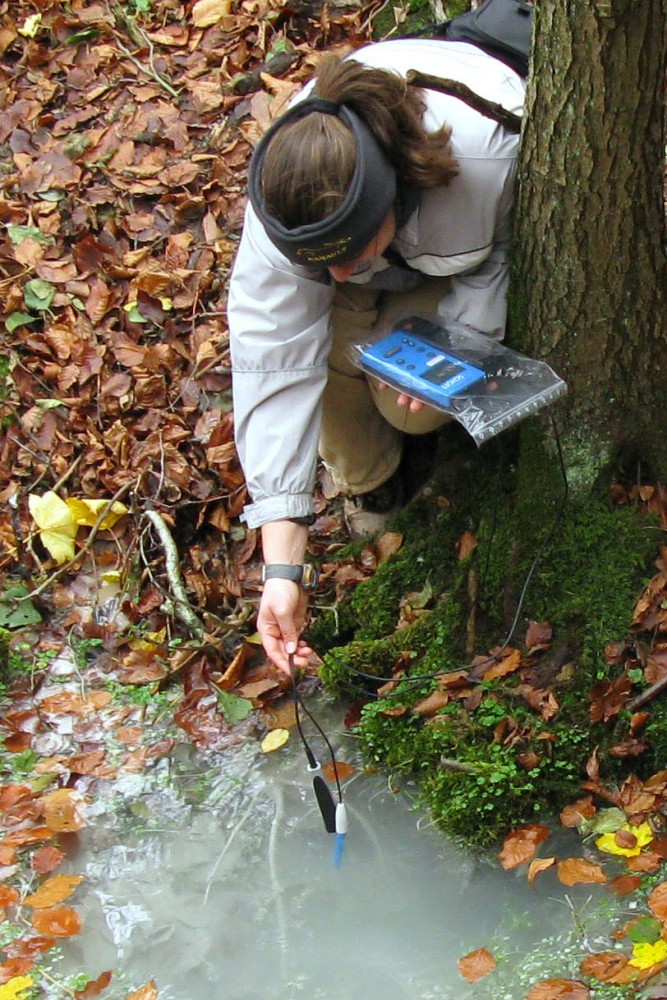
• Submarine Ground Water Discharge
• Ocean Acidification
• Phosphorous cycling
• Mineral Authigenesis
• Redox gradients
Current study areas:
• Baltic Sea
• North Sea
• Black Sea
• Mediterranean Sea
• South China Sea
Analytical methods:
Aqueous solutions:
- ICP-OES (major, minor, and trace elements)
- D/H, 18O/16O, 17O/16O, and 2H and 17O-excess in water (Picarro CRDS)
- Concentrations and 13C/12C in DIC and DOC; 34S/32S in e.g., sulfide, sulfate; 18O/16O in sulfate (gas mass spectrometry with different inlet systems- see 'isotope fascility')
- Spectrophotometry (sulfide, iron, phosphate, sulfate, alkalinity)
- Titration analyzer with autosampler (titration alkalinity, chloride)
- Ion sensitive electrodes, laboratory and field instruments, and microsensor stand (pH, oxygen microprofiling)
- Specific conductivity, temperature
Solid phases:
- Chemical sequential extraction lines (sulfur, metal, and phosphorous species)
- D/H and 18O/16O in mineral hydrate water (Picarro CRDS)
- 13C/12C in carbonates; 34S/32S in e.g., sulfides, sulfates; 18O/16O in carbonates and sulfates
(gas mass spectrometry with different inlet systems- see 'isotope fascility')
Experimental set-ups:
- Experimental set-ups to follow low-temperature dissolution and precipitation reactions under controlled conditions of temperature and CO2-partial pressure (in particular: carbonates, sulfates, phosphates (sulfides))
- Gas mixing device (CO2 - Ar/N2)
Sampling in the German Wadden Sea. Reference left: Al-Raei et al. (2009) Seasonal dynamics of microbial sulfate reduction in temperate intertidal surface sediments: controls by temperature and organic matter. Ocean Dynamics 59: 351–370. doi 10.1007/s10236-009-0186-5
Right: Sampling in a Brazilian lagoon
Running projects
There are always open projects for enthusiastic MSc and BSc students.
Please contact the group leader for further details.
-
DAAD (Impact of submarine and surface freshwater outflow on Baltic Sea coastal seas)DAAD (2018-2022) Stipend(PhD stipend: Dr. Cátia M. Ehlert von Ahn)
-
KISNET (Comparison of methods to investigate Submarine Groundwater Discharge)DFG (2020-2023)MSc Antonia Schell
-
BlackMan (The role of Mn-driven AOM on sediments of the Black Sea Biogeochemistry)Stipend (2019-2020)Dr. Tiantian Sun
-
COOLSTYLE (Biogeochemistry of Carbon storage in the North - Baltic Sea continuum (part of CARBOSTORE))BMBF (2021-2024)Dr. Càtia M. Ehlert von Ahn (PostDoc), MSc Antonia Schell
-